Hermes
Lost 1984 - Former US Coast Guard buoy tender, later a coastal freighter; scuttled as an artificial reef
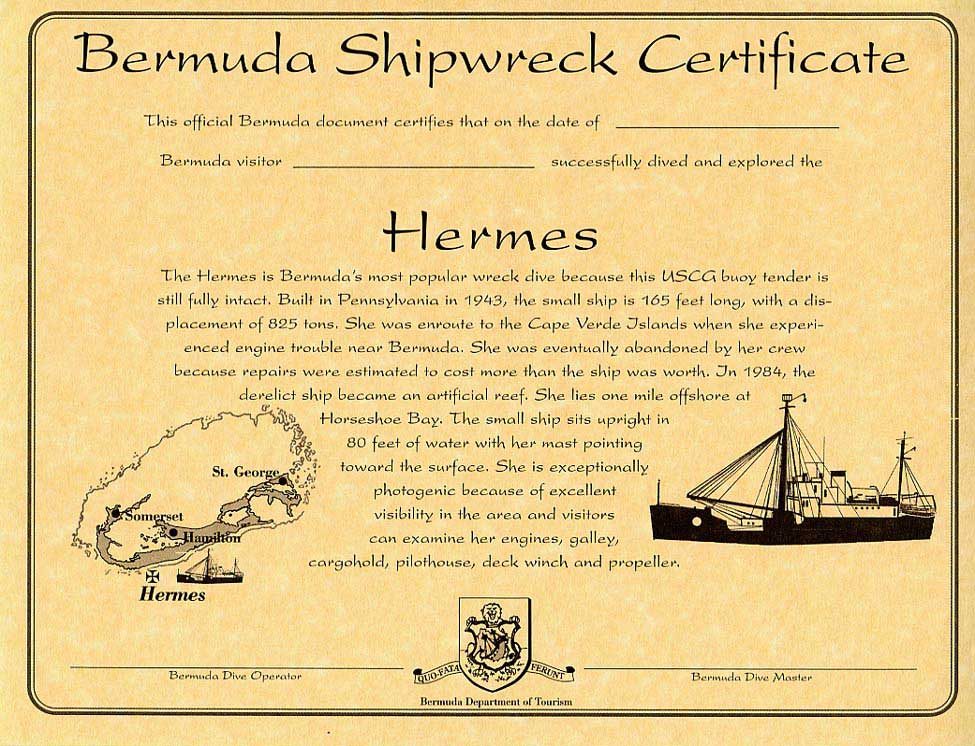
Image courtesy of the Government of Bermuda.
History
The Hermes began life in 1943 as a US Coast Guard buoy tender, built in Pennsylvania for wartime service. Her design gave her away: a tall mast forward of the wheelhouse, a single cargo boom and a big foredeck hatch for hoisting navigation buoys aboard for repair. After the war she was decommissioned and converted into a small freighter, registered in Panama as the Brava Fogo and later renamed Hermes.
In late 1983, bound from Rhode Island to the Cape Verde Islands on a mercy mission with donated goods for poor families there, she lost all electrical power when one of her generators caught fire. She drifted in the North Atlantic for four days until the cargo ship Sunmaria answered her distress calls and towed her into Bermuda on 1 December 1983. A couple of weeks later she set out for Jacksonville, only to limp back the next day after another generator fire. The Sunmaria's owners then took out a writ for salvage against her, so she could not leave until the courts had settled it; her twelve-man crew went home just before Christmas and a watchman was put aboard. Repairs would have cost more than she was worth and her Miami-based owners walked away, leaving her tied up in St George's for about five months. The Government first tried to sell her to an American buyer, who took one look at the rusting ship and asked for his $10,000 deposit back.
Instead she was handed to the Bermuda Dive Association (reportedly for one dollar). Volunteers stripped and cleaned her at Dockyard, removed her hatches so divers could get in safely, and drained her oil and fuel before she was scuttled about a mile off the South Shore on 15 May 1984. Hurricane Emily shifted her roughly 200 yards in 1985, but she remains upright and almost intact.
Diving the wreck today
Probably Bermuda's most popular wreck dive and an ideal first deeper wreck for Advanced divers. She sits upright on flat sand at 75-80 ft with a slight list to port, her mast reaching up toward the surface and the wheelhouse at around 45 ft. With the hatches removed, trained divers can look into the cargo hold, crew quarters, galley and engine room; the deck winch, cargo boom, toilet and wash basin are favourite photo subjects.
Visibility is typically around 100 ft, among the best of any Bermuda wreck. Because of the depth, watch your air and no-decompression time.
Where it is
Approximate position, for interest only - never use for navigation.
Sources & further reading
- Bermuda 100 - The Hermes
- Bermuda Tourism (gotobermuda.com) - Hermes
- Dive Bermuda at Somerset - Dive Sites
- Wikipedia - List of shipwrecks of North America (Bermuda section)
- Daniel & Denise Berg, Bermuda Shipwrecks: A Vacationing Diver's Guide (1991), pp. 30-31
- The Royal Gazette, 19 December 1983, p. 1 - 'Ship must go, says Minister'
- The Royal Gazette, 29 December 1983, p. 3 - 'Watchman on Hermes'