Iristo
Lost 1937 - Steam cargo ship (freighter)
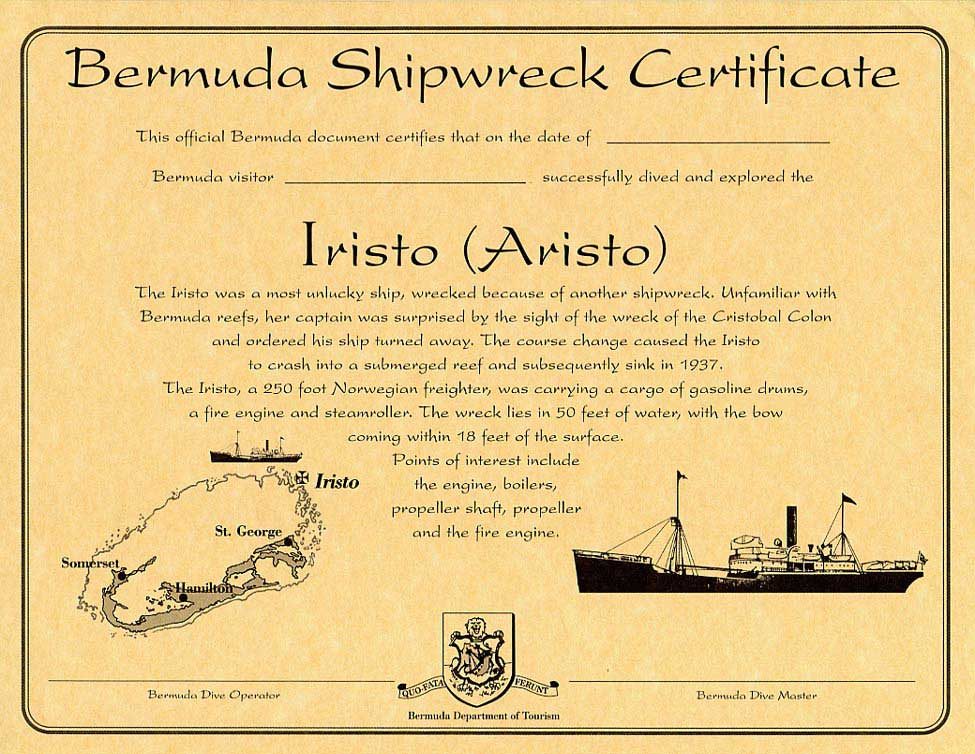
Image courtesy of the Government of Bermuda.
History
The Iristo was built in 1918 by the American Ship Building Company at Lorain, Ohio. She had been ordered for the British Government and was to be called War Briar, but when the United States entered the First World War every merchant ship on American slipways was requisitioned, and she was completed as the Great Lakes-type freighter Lake Jessup. She was sold in 1921, went to Norwegian owners as the Ekstrand in 1925, and in 1935 was bought by Hans F. Grann and renamed Iristo.
In March 1937, on charter to the Ocean-Dominion Line, she left St John, New Brunswick, for Bermuda on 11 March with 1,400 tons of general cargo - flour, peanuts, a fire engine and a steam roller among it - and about 200 barrels of gasoline and oil on deck. Her master, Captain Christian Stephensen, was navigating by a small-scale Admiralty chart that had not been corrected since 1932. At four in the afternoon of 15 March, in rain so heavy that he could see only 10 or 15 yards, he made out the Spanish liner Cristobal Colon - wrecked the previous October and still standing upright on the reef - took her for a ship under way, and held his course. The Iristo ran onto Curlew Boiler, between the North Rock light and the Colon. She floated off within a couple of hours and the tug John S. Darrell took her in tow, but she was leaking badly amidships, and at 7.30 that evening, afraid the water would reach the boilers, Stephensen ordered her abandoned. Two tow ropes parted, the drums of gasoline on deck exploded, and at about 2 a.m. on 16 March, after the tugs John S. Darrell and Powerful had dragged her eight or nine miles towards St George's, she went down by the bow half a mile outside the North East Breaker buoy. All her crew were saved. Over the following days motor boats brought bags of flour and peanuts that had floated out of the wreck to King's Square in St George's.
A commission of inquiry found Stephensen 'gravely negligent': he had no properly corrected chart and no Notices to Mariners - he admitted he had been too busy to get them at St John - and had taken poor bearings of the North Rock beacon. It also recommended cutting down the Colon's funnel and at least one mast so that no one else would mistake her for a ship under way. The common local spelling 'Aristo' is often blamed on a New York Times misprint, though the Royal Gazette was already using it in its first report of the stranding.
Diving the wreck today
A classic, fairly intact wreck that suits Open Water divers with some experience. She sits mostly upright in 50-55 ft with the bow rising to within about 18 ft of the surface and the stern standing well off the bottom. Look for the engine, boilers, propeller shaft and two big anchors, and the remains of the fire engine - wheel parts and even tyres can still be made out under decades of coral. Chub, horse-eye jacks and the odd octopus live on the wreck, and winter visibility can exceed 150 ft.
Where it is
Approximate position, for interest only - never use for navigation.
Sources & further reading
- Bermuda 100 - Iristo (Aristo)
- Government of Bermuda - Open Shipwrecks and Protected Moorings Program
- PADI - Iristo/Aristo dive site
- Wikipedia - List of shipwrecks of North America (Bermuda section)
- Daniel & Denise Berg, Bermuda Shipwrecks: A Vacationing Diver's Guide (1991), pp. 32-33
- Custodian of Historic Wrecks, notice classifying open and restricted wrecks under s.6(1) of the Historic Wrecks Act 2001 (13 July 2007)
- The Royal Gazette and Colonist Daily, 17 March 1937, p. 1 - 'Freighter Sinks While Being Towed to Port'
- The Royal Gazette and Colonist Daily, 27 March 1937, p. 1 - 'Captain of Sunk Ship "Gravely Negligent"'