L'Herminie
Lost 1838 - Sailing frigate, 60 guns (Surveillante class)
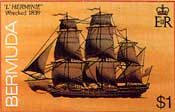
Image courtesy of the Government of Bermuda.
History
L'Herminie was one of a group of big sailing frigates designed for the French Navy by Martin Boucher in the 1820s, and among the last French warships of her kind built before steam power arrived. She was completed at Lorient in 1828 and carried 60 guns.
In 1837-38 she served with the French squadron that blockaded Veracruz and other Mexican ports during France's dispute with Mexico, and in the summer of 1838 her commander, Commodore Bazoche, was in charge of the French naval forces in the Gulf. She later put into Havana, and within about three months yellow fever had laid low 133 of her crew. A ship's company in that state was no use for fighting, so she was ordered home to Brest.
Seventeen days out of Havana, on the afternoon of Monday 3 December 1838, she raised Bermuda from the west. The Royal Gazette reported that the land was seen before she struck, "but it was not imagined that the reefs extended so far out". To be safe her course was altered two points, but soon afterwards she ran onto the Chub Bar, seven and a half miles west of Ireland Island, and almost at once bilged. The weather was moderate. Boats from the Dockyard under Mr Sunholm reached her at about nine that night and, with the Somerset boats, took off all 495 officers and men, the Commodore among the last to leave; they were landed at Ely's Harbour. Next morning the Government steam vessel, the Dockyard boats and men of HMS Andromache began saving her stores.
The Naval Storekeeper, Joseph Ballingall, housed the Frenchmen in the receiving ship Royal Oak at Ireland Island and fed them from the Naval Yard. Bazoche then chartered three vessels, the Hercules, the Jean and the Osage, which sailed on 22, 23 and 26 December to carry the crew to Martinique. Thomas R. Tucker of Somerset acted as agent for the wreck, gathering what had been saved into stores at Ely's Harbour, and in March 1839 a French troopship took the recovered munitions on to Martinique. That spring Bazoche and his officers published a letter of thanks to the people of Bermuda, and a court martial at Brest found that the loss was no fault of his: he was honourably acquitted and his sword was handed back to him.
Divers came back to her in the twentieth century. In July 1960 Governor Sir Julian Gascoigne made two dives on the wreck with Harry Cox on the first trip of the Bermuda Divers Company, the first Governor to explore the outer reefs in an aqualung, and finds from her were later shown at the Smithsonian Institution. An officer's gorget is in the National Museum of Bermuda collection and a group of her glass bottles is in a private Bermudian collection. Bermuda 100, working with the Custodian of Historic Wrecks, has recorded the site in 3D.
Diving the wreck today
This is one of Bermuda's showpiece historic wrecks. The wooden hull has almost entirely gone, but around forty iron cannon lie scattered across the sand and coral among tall coral heads, and sharp-eyed divers can sometimes pick out cannon balls too. The best-known spot is a pair of guns lying crossed over each other, a favourite with photographers; there is also a huge fluted anchor and the remains of iron water tanks. The water is shallow and usually clear, so it suits divers of all levels in calm weather and is also good for snorkelling from a boat.
Because the site sits well out on the western reefs it depends on sea conditions. Everything on the wreck is protected: look, but do not touch or remove anything.
Where it is
Approximate position, for interest only - never use for navigation.
Pictures
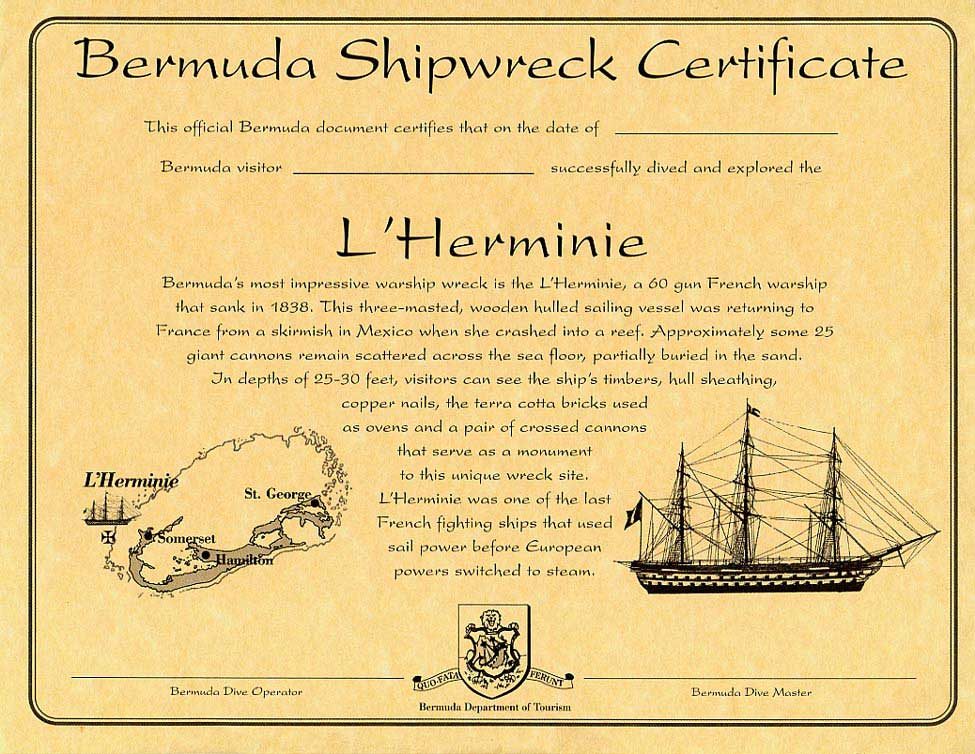 Bermuda Shipwreck Certificate (former Department of Tourism programme)
Sources & further reading
- Bermuda 100 (UC San Diego) - L'Herminie
- Navypedia - Surveillante class frigates
- Wikipedia - List of shipwrecks in December 1838
- National Museum of Bermuda - Gorget from the L'Herminie, 1838
- Bermuda.com - Bermuda's Shipwreck Postage Stamps (1986 set)
- Daniel & Denise Berg, Bermuda Shipwrecks: A Vacationing Diver's Guide (1991), pp. 38-40
- Ivor Noel Hume, Shipwreck! History from the Bermuda Reefs (1995), pp. 3, 47
- Custodian of Historic Wrecks, notice classifying open and restricted wrecks under s.6(1) of the Historic Wrecks Act 2001 (13 July 2007)
- The Royal Gazette (Bermuda), 11 December 1838, p. 2 - report of the wreck of the French frigate L'Herminie
- The Royal Gazette (Bermuda), 2 July 1839, p. 2 - court martial and acquittal of Commodore Bazoche (from The Times)