Madiana
Lost 1903 - Iron screw passenger and cargo steamer
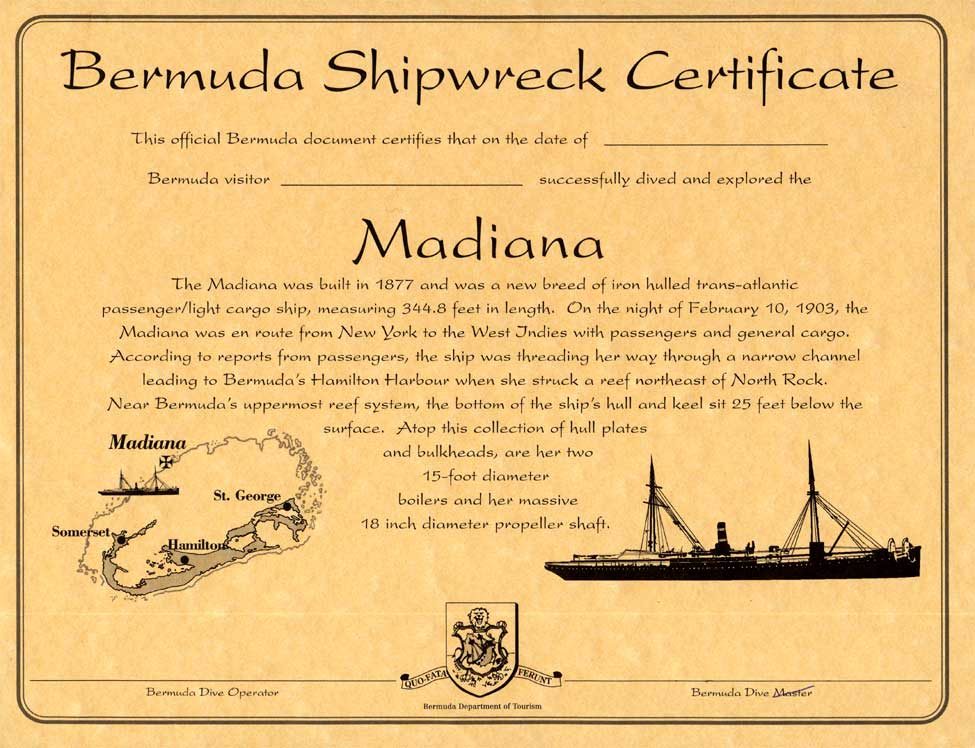
Image courtesy of the Government of Bermuda.
History
The Madiana began life as the Balmoral Castle, an iron-hulled passenger and cargo liner launched at Govan by Robert Napier & Sons in 1876 for Donald Currie's Castle Line. She passed through several owners, spent some years under the Spanish flag as the San Augustin (surviving a serious fire off northern Spain in 1883), and in the early 1890s was bought by the Quebec Steamship Company and renamed Madiana for its New York-Bermuda-West Indies service.
She left New York on the afternoon of Saturday 7 February 1903 on a special winter cruise among the Caribbean islands, with Bermuda her first call; only four of her passengers were bound for the island. Her master, Captain Roderick Fraser, had been running to Bermuda for twenty years. At about 3 a.m. on the 10th, with the first officer on the bridge and the third officer at the masthead watching for St David's light, Fraser made out a blurred light that showed no flash. He took it for St David's and steadied the ship at East, and minutes later she was on the outer reef about a mile west of North Rock, at a spot the Royal Gazette called Dickey Boiler. Her rockets were seen ashore by a man named Trott, who did not understand them and raised no alarm.
At daybreak the tug Gladisfen under Captain Chester put out, losing one of her own boats on the way, and the steamboat Harry E. Packer followed. Because the Madiana lay broadside to the reef the passengers could be taken off, and everyone aboard, the mails and most of the baggage reached the tugs safely. The Marine Court of Inquiry that sat later that month worked out that she was some 24 miles from where Fraser believed himself to be: the light he saw must have been Gibbs Hill, whose range had officially been cut to about 18 miles the year before, a notice Fraser said he had never seen. The court blamed him for a bad noon position, for keeping up full speed after failing to sight a light, for not knowing about Gibbs Hill and for steadying at East after breakers were reported, though it made no order against his certificate; it also found Gibbs Hill light too weak to protect ships approaching from the north at night. Fraser later told New York reporters that smoky tin reflectors had made the light look fixed. Afterwards the American consul in Bermuda was accused of neglecting the stranded passengers, and Washington ordered an inquiry into his conduct. The wreck was partly salvaged during the Second World War, when her engine was removed.
Diving the wreck today
The Madiana is a big, sprawling wreck on a hard coral bottom at about 25 ft. The engine is gone, but the twin boilers and the propeller shaft are still there, and the stern hangs out over a sand hole. Plates and ribs are encrusted with coral and alive with reef fish.
The shallow depth and visibility that is often 80-100 ft make it a good dive for most levels in calm weather, and it is often combined with the nearby Caraquet.
Where it is
Approximate position, for interest only - never use for navigation.
Sources & further reading
- Wikipedia - SS Madiana
- Bermuda 100 (UC San Diego) - The Madiana
- Bermuda.com - Bermuda's Shipwreck Postage Stamps (1986 set)
- Daniel & Denise Berg, Bermuda Shipwrecks: A Vacationing Diver's Guide (1991), pp. 40-42
- Custodian of Historic Wrecks, notice classifying open and restricted wrecks under s.6(1) of the Historic Wrecks Act 2001 (13 July 2007)
- The Royal Gazette Extra (Bermuda), 10 February 1903 - 'The S.S. "Madiana" a Total Wreck'
- The Royal Gazette (Bermuda), 21 February 1903, pp. 2-3 - Marine Court of Inquiry, evidence and judgment