North Carolina
Lost 1880 - Iron-hulled sailing barque
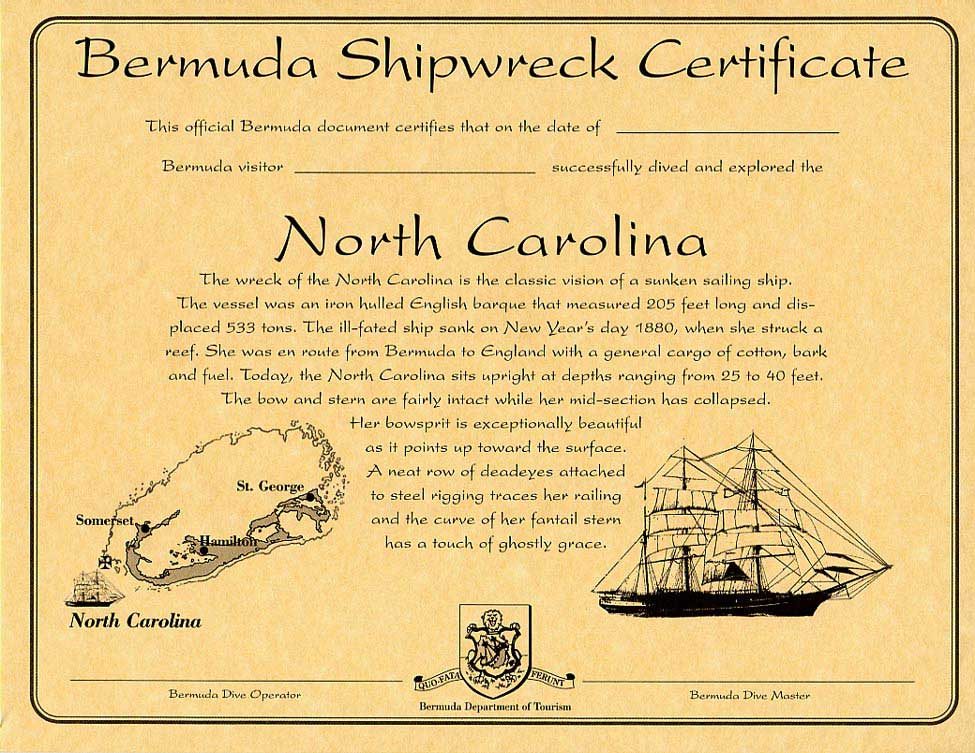
Image courtesy of the Government of Bermuda.
History
The North Carolina was a three-masted iron barque built on the Clyde in 1876, registered in Liverpool and owned by H. Barber. In late 1879 she was on her way from Baltimore to Liverpool with cotton, bark and general cargo when rudder damage forced her into Bermuda, where she arrived at St George's in distress in November for repairs.
She sailed from St George's for Liverpool on 30 December 1879 under Captain Alexander Buchan, but early on the morning of New Year's Day 1880 she ran onto the Long Bar to the west of the island, in very fine weather; the Royal Gazette heard that she had sprung a leak and was heading back to port. An anchor was driven through her bottom as she went onto the reef, and she soon lay full of water, though much of her cotton was brought ashore. On Thursday 22 January an attempt was made to float her and bring her in, but the anchor, which everyone thought was firmly wedged, fell out of the hole and she settled "head foremost" in comparatively deep water. The Board of Trade casualty returns put the wreck about 8.5 miles west and half a mile south of Gibbs Hill Lighthouse.
By bad luck Bermuda's Marine Court of Inquiry Act had lapsed only hours before she struck, so the court that met in January had no powers. A special bill to let the Governor appoint commissioners to take evidence then failed in the legislature, and no official inquiry into her loss was ever held. Her hull, boats, sails and new rigging were auctioned in February 1880.
Diving the wreck today
The North Carolina is often called one of Bermuda's prettiest wrecks. She sits upright on sand between 25 and 45 ft, with the bow and the graceful stern largely intact and the midships collapsed. The bowsprit still angles up towards the surface, and rows of deadeyes and rigging line her rails. Coral and sponges cover the hull, and hogfish and snapper are common.
It is a good dive for all levels in calm conditions, but the fine sand stirs up easily, so careful buoyancy keeps the visibility clear.
Where it is
Approximate position, for interest only - never use for navigation.
Sources & further reading
- Department of Environment and Natural Resources - The North Carolina
- Bermuda 100 (UC San Diego) - The North Carolina
- Bermuda.com - Bermuda's Shipwreck Postage Stamps (1986 set)
- Daniel & Denise Berg, Bermuda Shipwrecks: A Vacationing Diver's Guide (1991), pp. 48-49
- Custodian of Historic Wrecks, notice classifying open and restricted wrecks under s.6(1) of the Historic Wrecks Act 2001 (13 July 2007)
- The Royal Gazette (Bermuda), 6 January 1880, p. 2 - the barque North Carolina ashore on the Long Bar
- The Royal Gazette (Bermuda), 27 January 1880, p. 2 - 'The Barque North Carolina'