San Pedro
Lost 1595 - Spanish merchant nao (New Spain fleet)
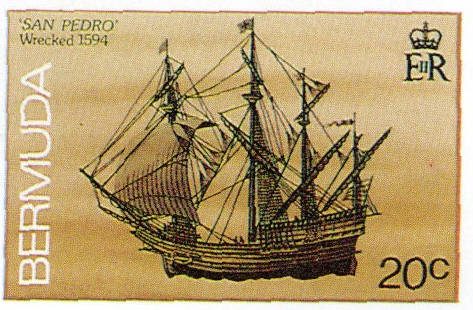
Image courtesy of the Government of Bermuda.
History
The San Pedro was a Spanish merchant nao of about 350 tons sailing home from Cartagena to Cadiz with the New Spain fleet in the mid-1590s; one account names her captain as Hieronimo de Porras. Caught by a storm and separated from her escort, she was torn open on Bermuda's outer reefs. Spanish documents in Madrid and Seville record a San Pedro as lost at Bermuda, and a silver coin minted in 1592 shows the wreck can be no earlier; she is dated here to 1595, the year given by Teddy Tucker and Ivor Noel Hume, though other accounts say 1594 or November 1596. Nothing found has proved the identification, though the anchor and iron guns fit a merchant ship rather than a galleon.
In about 1951 Teddy Tucker, out looking for lost fish traps (other accounts say following a fisherman's report of 'marble columns'), spotted cannon on the seabed in some 25-30 feet of water near North Rock; he and Bob Canton raised six iron guns, which were sold to the Monuments Trust and shown at the Aquarium, and Tucker called the site his 'old Spaniard'. The real treasure came in August 1955, when in ten days' work he and Canton dug into the sand and raised timbers, porcelain and pottery, pewter, tools, navigating instruments, a bronze mortar dated 1561, Carib Indian weapons (among them a wooden ceremonial staff whose carving the sand kept crisp), a lead or pewter tobacco pipe, silver coins (accounts vary from about 200 to 2,000), a 32-ounce gold bar and small gold cakes, pearl-set gold buttons - and a 22-carat gold cross set with seven emeralds. It became famous as the Tucker Cross and was hailed as the most important treasure find of its day in the western hemisphere. It was the first of only three true treasures ever found in Bermuda's waters; Tucker found the second, the Spanish San Antonio of 1621, three years later.
The find was made public in January 1956, and a six-page story in Life magazine made it world news. That year the Royal Gazette published research by Park Breck suggesting the wreck was instead the French ship of de la Barbotiere, lost near North Rock in December 1593 with the Englishman Henry May aboard - an alternative identification that has never been settled. Ownership of the treasure was disputed for years; meanwhile Tucker and the Cantons showed it in their own Wreck Museum in Hamilton, opened in 1959. A Government purchase failed on a tied vote in the Legislative Council in July 1961, and was finally approved on 28 November 1961 for GBP 35,600. In 1975, as pieces were being chosen for Queen Elizabeth II's visit to open the maritime museum at Dockyard, the cross was found to have been swapped for a cheap replica. The real cross has never been recovered.
Diving the wreck today
The San Pedro is not a buoyed or publicised dive site, and its position is not published. The Bergs' 1991 guide describes it as a sand hole 15-30 ft deep where only some timbers and a ballast pile remain exposed. Its story is told at the National Museum of Bermuda at Dockyard.
Sources & further reading
- Teddy Tucker - Bermuda's Crown Jewels
- Mental Floss - The Mystery of Tucker's Cross
- Wikipedia - Tucker's Cross
- Wikipedia - List of shipwrecks of North America (Bermuda section)
- Bermuda.com - Bermuda's Shipwreck Postage Stamps (1986 issue)
- Daniel & Denise Berg, Bermuda Shipwrecks: A Vacationing Diver's Guide (1991), pp. 57-59
- Ivor Noel Hume, Shipwreck! History from the Bermuda Reefs (1995), pp. 13-14, 54
- The Royal Gazette, 5 January 1956, p. 1 - ''Fabulous Treasure' Is Found In Bermuda'
- The Royal Gazette, 29 November 1961, p. 1 - 'Teddy Tucker Treasure Purchase Agreed'