Blanche King
Lost 1920 - Four-masted schooner (iron frame, wooden planking, centreboard)
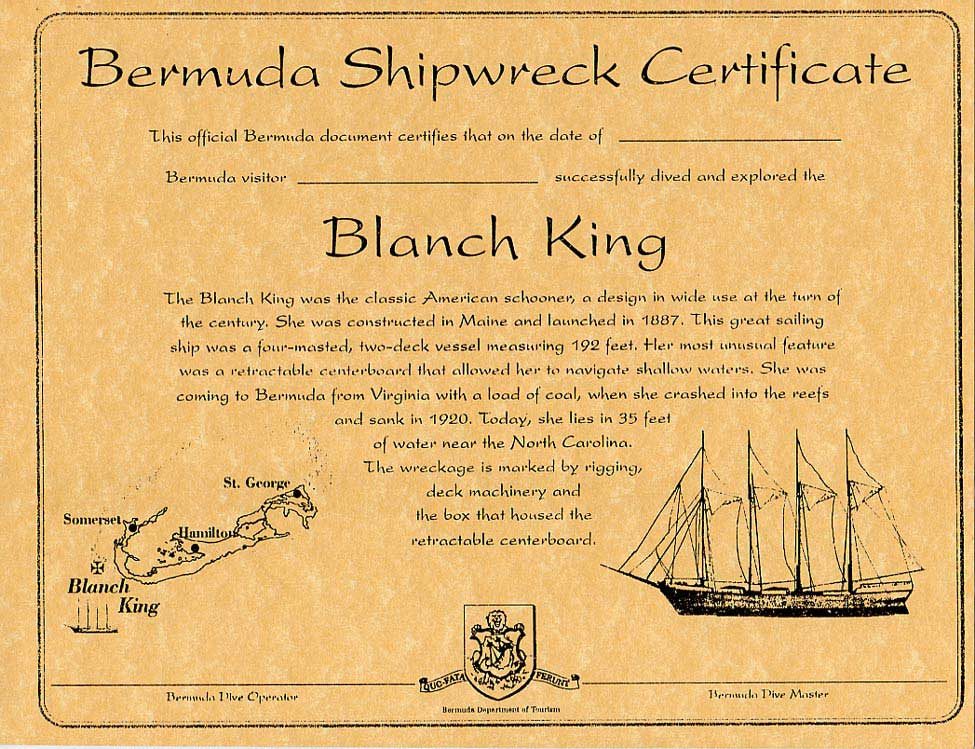
Image courtesy of the Government of Bermuda.
History
The Blanche H. King - usually called simply the Blanche King - was a big American four-masted schooner built in 1887 by the New England Shipbuilding Company at Bath, Maine, for T.T. Anderson. She was of composite construction, with an iron frame and wooden sides, and her unusual feature was a large drop keel (centreboard) that could be raised, letting her carry coal up shallow rivers to timber mills despite her size. She changed hands five times in her 33 years, ending with the U.S. Shipping Company.
On 2 December 1920, under Captain Pattison and carrying coal from Norfolk, Virginia to Bermuda, she went aground on the south-west reefs near the Chub Heads beacon. She settled into a sand hole between the reefs in about 35 ft of water and was lost, but all eight men aboard got off safely. A month later, on 5 January 1921, what could be saved from 'the stranded four-masted Schooner Blanche H. King' went under the hammer in Hamilton: sails, hawsers, blocks, flags, crockery and ship's stores, along with a barrel of beef, tubs of margarine, rolled oats, pilchards, damaged flour, a case of books, three gentlemen's bicycles and a canoe.
The wreck appears on the 1977 Receiver of Wreck list and is one of the buoyed, protected sites under the Bermuda Dive Sites programme.
Diving the wreck today
A straightforward 35 ft dive suitable for beginners, though visibility can be lower than at some West End sites. The iron hull has largely collapsed and the upper deck has gone, but wooden remains are still attached to the mid-deck frames and the centreboard trunk stands in place amidships. Wire cable, rigging and deadeyes are scattered over the wreck and surrounding reef, with a capstan at the bow, some machinery, and ballast exposed at the stern.
Where it is
Approximate position, for interest only - never use for navigation.
Sources & further reading
- Bermuda Department of Environment - Blanche King
- Bermuda 100 (UC San Diego) - Blanche King
- Wikipedia - List of shipwrecks of North America
- Daniel & Denise Berg, Bermuda Shipwrecks: A Vacationing Diver's Guide (1991), p. 11
- Custodian of Historic Wrecks, notice classifying open and restricted wrecks under s.6(1) of the Historic Wrecks Act 2001 (13 July 2007)
- The Royal Gazette and Colonist Daily, 4 January 1921, p. 4 - auction notice, 'the stranded four-masted Schooner Blanche H. King'