Caesar
Lost 1818 - Brig (brigantine)
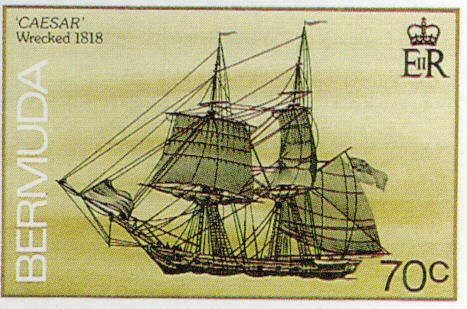
Image courtesy of the Government of Bermuda.
History
The Caesar was a British brig built in County Durham in 1814. In 1818 she sailed from Newcastle-upon-Tyne for Baltimore under Captain Joseph Richardson, with a supercargo and a crew of seven, carrying a typical mixed cargo of English goods: leather, kegs of white and red lead and other paints, boxed sets of wine glasses, tumblers and decanters, apothecaries' jars and stoppered vials, fluted and figured pocket flasks, porter by the cask and crates of empty bottles, eight-day clock movements, watch glasses, lead shot, carpeting, plate glass, heavy grindstones and bricks, and a marble cornice ordered for a Baltimore church.
On 17 May 1818 she stranded on the rocks off Bermuda's West End. Salvors brought what they could to Mrs Ruth Prudden's stores at Somerset Bridge, and on 20 July the agents, Robert Tucker & Sons, auctioned her cables, boats and sails, the saved goods, and the hull itself 'with a part of the Cargo, as it now lies on the Rocks' - the Bermuda Gazette's advertisement, which promised bidders a cold cut, reads like an inventory of the wreck. Lloyd's List carried the news in London that July. The site was then forgotten until 1957, when Teddy Tucker rediscovered it in a sand hole and raised more cargo using Herbie Smith's salvage boat The Ruby. Archaeologist Ivor Noel Hume identified some of the decorated flasks from the wreck as New Hampshire glass and suggested they were empties from a Masonic dinner in London. The 1818 sale list points to a simpler explanation for at least some of them: crates of 'pocket bottles, fluted & figured' were part of the cargo itself, shipped from Newcastle for sale in America. Bricks from the wreck were used in restoring the old Rum Runners building in Hamilton, and grindstones turned up as sharpening stones and garden paths.
Diving the wreck today
An easy 25-35 ft dive in a sand hole surrounded by reef. Stacks of grindstones, some weighing more than a ton, rest on the remains of the wooden hull, and after winter storms the bottom timbers are well exposed. Necks and bases of black glass bottles lie among the timbers, and lead shot collects in the shallows. Storms can bury or uncover the site from year to year. Good fish life; suitable for all levels and close to the Airplane.
Where it is
Approximate position, for interest only - never use for navigation.
Pictures
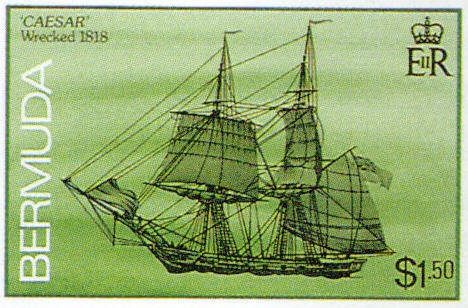 Bermuda postage stamp from the shipwreck series
Sources & further reading
- Bermuda Department of Environment - Caesar
- Bermuda 100 (UC San Diego) - Caeser
- Wikipedia - List of shipwrecks of North America
- Bermuda.com - Bermuda's Shipwreck Postage Stamps
- Daniel & Denise Berg, Bermuda Shipwrecks: A Vacationing Diver's Guide (1991), pp. 12-14
- Ivor Noel Hume, Shipwreck! History from the Bermuda Reefs (1995), pp. 3, 5, 13
- Custodian of Historic Wrecks, notice classifying open and restricted wrecks under s.6(1) of the Historic Wrecks Act 2001 (13 July 2007)
- The Bermuda Gazette, 11 July 1818, p. 3 - Notice to Salvors and Sale by Auction, brig Caesar, Joseph Richardson, master
- The Bermuda Gazette, 23 May 1818, p. 2 - Custom-House Hamilton (brig Caesar stranded off the West End)