Caraquet
Lost 1923 - Mail and passenger steamer (Royal Mail Steam Packet Company)
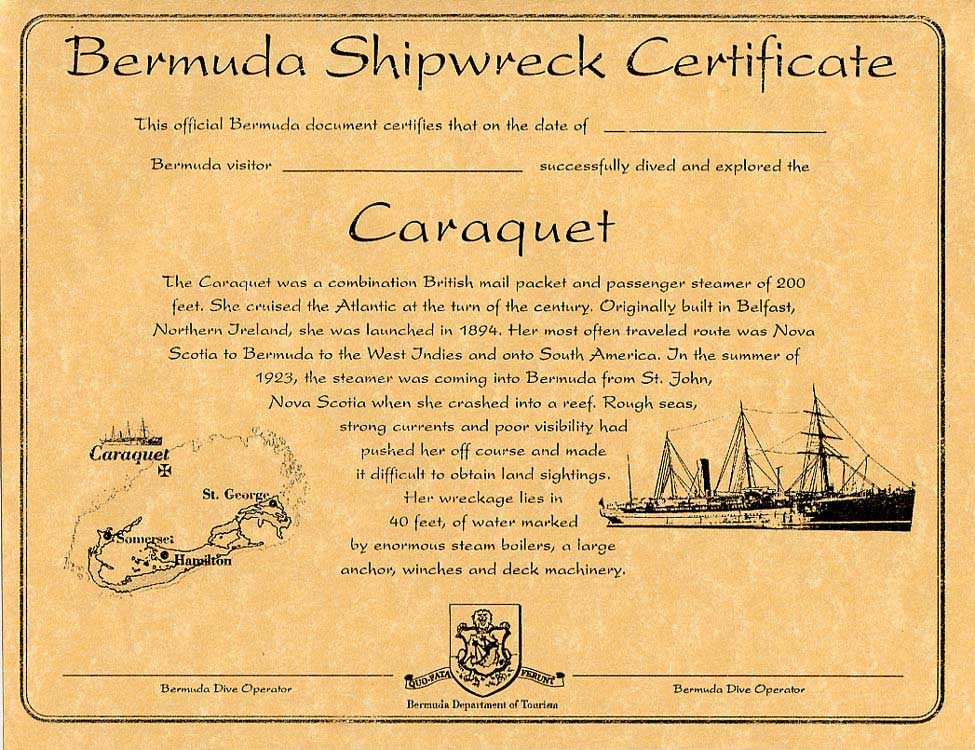
Image courtesy of the Government of Bermuda.
History
The ship began life in 1894 as the Guelph, built by Harland & Wolff at Belfast for the Union Line's South African service and passing to Union-Castle in the 1900 merger. Around 1913 the Royal Mail Steam Packet Company bought her for its Canada - West Indies - British Guiana service and renamed her Caraquet.
She left Halifax on Friday 22 June 1923 with mail, a large cargo and passengers for Bermuda and the West Indies, among them fifty-five Chinese travellers bound for the Caribbean. Fine weather gave way to heavy seas, rain and a 'very hazy atmosphere', and on the morning of Monday 25 June, soon after breakfast, with some of the passengers playing quoits on deck, she struck Bermuda's northern barrier reef at speed about three miles west of North Rock, pounding two or three times and flooding her engine room. She had not yet taken on a pilot. The lifeboats took everyone off, and passengers, crew and mail were landed at St George's. The Royal Gazette recalled that the Lamport & Holt steamer Newton had gone ashore in almost the same spot two years earlier.
An American wrecking tug, the I. J. Merritt, examined her in early July and judged her not worth raising. In August the wreck, her seven lifeboats, about 1,300 tons of bunker coal and some 2,000 tons of cargo still aboard - flour, lumber and fish - were sold at auction to a Mr O. Lindley. The Marine Court of Inquiry found that an abnormal south-westerly current had set her off course during the last hours of the run, and that the haze was purely local; it exonerated Captain Hernandez, while believing an error in latitude had been made.
Herbie Smith salvaged her at the time and again after the Second World War, stripping most of the copper, brass and bronze, and Teddy Tucker later raised her bronze propeller.
Diving the wreck today
A shallow, spread-out wreck covering almost two acres of reef and sand in about 30-45 ft of clear water. The hull and decks are flattened, but the engine, four big boilers, deck plates, capstans, two big deck winches, plenty of lead pipe and a massive anchor with one fluke pointing straight up are easy to find. Yellow grunts gather here in spring. Fine for beginners in calm weather, but the site is exposed and winter storms can make it undiveable.
Where it is
Approximate position, for interest only - never use for navigation.
Sources & further reading
- Bermuda Department of Environment - Caraquet
- Bermuda Department of Environment - Shipwreck series: The Caraquet
- Bermuda 100 (UC San Diego) - Caraquet
- B&C Staff Register - Guelph/Caraquet
- Wikipedia - List of shipwrecks in June 1923
- Bermuda.com - Bermuda's Shipwreck Postage Stamps
- Daniel & Denise Berg, Bermuda Shipwrecks: A Vacationing Diver's Guide (1991), pp. 14-15
- Custodian of Historic Wrecks, notice classifying open and restricted wrecks under s.6(1) of the Historic Wrecks Act 2001 (13 July 2007)
- The Royal Gazette and Colonist Daily, 26 June 1923, p. 1 - 'Caraquet Strikes Northern Reef. Feared Total Loss.'
- The Royal Gazette and Colonist Daily, 24 July 1923, p. 1 - 'The Marine Court of Inquiry. Captain of Caraquet Exonerated.'