Constellation
Lost 1943 - Four-masted wooden schooner
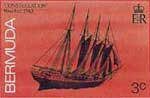
Image courtesy of the Government of Bermuda.
History
Launched in Maine in 1918 as the Sally Persis Noyes, this four-masted wooden schooner first sailed in the Crowell & Thurlow fleet. In 1932 Robert Royall of East Boothbay bought her, renamed her Constellation and rebuilt her with electricity, refrigeration and roomy staterooms, meaning to run her as a sea-going school. The idea found few takers; she was soon up for sale and spent most of the next decade idle in New York.
The Second World War gave old sailing ships new work. Converted back to a cargo carrier for the Inter-Continental Steamship Company, on 19 July 1943 she left New York for La Guaira, Venezuela, with a remarkable mixed cargo: bags of cement and building supplies, hundreds of cases of Scotch, cosmetics, glassware, phonograph records, crockery and large quantities of medical drugs in glass ampoules, including morphine. She began to leak on 25 July, and when her steam pumps broke down four days later the crew pumped by hand until they would pump no more; her 71-year-old master, Captain Howard Neaves, turned for Bermuda. She had no radio and no engine, and the Bermuda chart had been put away in a drawer and could not be found. Gibbs Hill lighthouse was sighted at 9 a.m. on 31 July. Neaves skirted the north-west reefs looking for a pilot, and when the lead showed five fathoms he kept going - he was, he told the inquiry, 'in a mighty big hurry'. At 2.10 p.m., making about three knots, she struck the reef at Western Blue Cut and settled in about 30 ft of water. All nine aboard were rescued, and her back broke on the night of 6 August. The marine court found Neaves negligent - he had posted no lookout and should have anchored - and found the ship herself in poor condition, her bowsprit rotten.
Wartime censorship kept the wreck out of the Royal Gazette for two weeks, but from August to November 1943 her salvaged cargo was auctioned in Hamilton lot by lot: nail polish, radios, Scotch whisky, baseball bats, mayonnaise, window glass and carpets among it. Darrell Brothers did the salvage, Bert Darrell recovered parts of the ship, and the US Navy retrieved hundreds of cases of whisky; much of the rest stayed on the seabed.
The drug ampoules gave Peter Benchley the idea for his novel The Deep, in which the ship becomes the Goliath, and its treasure hunter Romer Treece (Robert Shaw in the 1977 film) was modelled on Bermuda's Teddy Tucker. The film was shot largely in Bermuda, and the wreck became one of the island's most famous dives.
Diving the wreck today
An easy, shallow dive or snorkel in about 25-35 ft. The paddle-steamer Montana lies only about 50 ft away, so close that the two are easily taken for one wreck, and both are usually seen on one trip. The wooden hull has mostly gone; the centre of the site is a large mound of cement bags that set solid on the seabed. Her nickname, the Woolworth Wreck, comes from the variety of small goods found here over the years - bottles, crockery, tiles, nail-polish bottles, tennis rackets, yo-yos and lead crucifixes among them - and small glass ampoules still turn up in the sand. Nothing may be removed. Plenty of reef fish; suitable for all levels.
Where it is
Approximate position, for interest only - never use for navigation.
Sources & further reading
- Bermuda 100 (UC San Diego) - Constellation
- Bermuda Department of Environment - Constellation
- Bernews - Exploring Bermuda's most famous shipwreck
- Bermuda.com - Bermuda's Shipwreck Postage Stamps
- Wikipedia - List of shipwrecks of North America
- Daniel & Denise Berg, Bermuda Shipwrecks: A Vacationing Diver's Guide (1991), pp. 17-20
- Ivor Noel Hume, Shipwreck! History from the Bermuda Reefs (1995), p. 2
- Custodian of Historic Wrecks, notice classifying open and restricted wrecks under s.6(1) of the Historic Wrecks Act 2001 (13 July 2007)
- The Royal Gazette and Colonist Daily, 21 August 1943, p. 1 - 'Court Find Master Of Schooner Negligent'
- The Royal Gazette and Colonist Daily, 17 August 1943, p. 1 - 'Captain Testifies On Schooner's Stranding'