Cristóbal Colón
Lost 1936 - Passenger liner
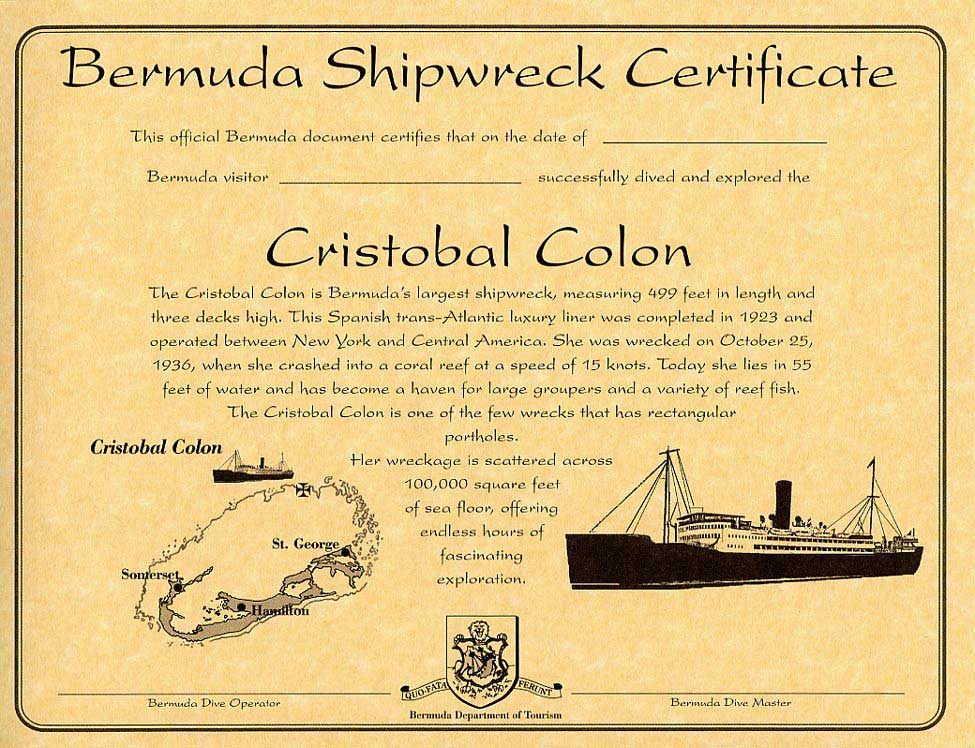
Image courtesy of the Government of Bermuda.
History
Launched at El Ferrol in 1923 for the Spanish Line, the Cristóbal Colón was a modern liner of nearly 500 ft and one of the most luxurious of her day, running mainly between Spain, New York and Central America. The Spanish Civil War caught her mid-voyage in 1936: homeward bound from Mexico with 344 passengers, she was barred from rebel-held Vigo, turned away at Southampton and left waiting in France, until in August a left-wing crew took her over.
On 16 October she left Cardiff for Veracruz in ballast, with no passengers and a crew of about 160 - reportedly to collect arms. Late on the night of 24 October, at full speed on a course that should have taken her some twenty miles north of the islands, she ran hard onto the reef east of North Rock and stuck fast, her bow eight feet higher than her stern. The North Rock beacon had been out since 19 October; Captain Crescencio Navarro Delgado told the court of inquiry that he had taken another light for it, and it came out that the wireless operator had been listening to broadcasts from Madrid rather than to the shore stations. The court did not accept that the dark beacon was the whole story: it found the stranding 'mainly due to negligence on the part of the Captain', and recommended that the North Rock light be converted from carbide to acetylene. The story told in later years, that her officers mistook a radio mast for Gibbs Hill Lighthouse, does not appear in the contemporary reports.
No one was hurt. A night watchman at the West India Oil Company tanks saw her plight and telephoned the pilot station, and by 3 a.m. the tugs John S. Darrell and Powerful were on their way out; six Spanish stewardesses were brought ashore and lodged at the Sailors' Home. The stranded Spaniards were unwelcome guests whom no government would pay for, so Bermuda set them to work repairing Barry Road and restoring Gates Fort until they sailed for Europe on Christmas Eve.
Efforts to pull her off failed. Her furnishings, paintings and fittings were auctioned, and local boats stripped her by night; of the hundreds who joined in, only 13 were caught. Pieces of the ship still decorate Bermudian homes. In 1937 the Norwegian steamer Iristo was wrecked nearby after mistaking the stranded liner for a ship under way, after which her funnel and mast were taken down so she would mislead no one else. By 1939 she had broken in two, and during the Second World War the hulk was used as a bombing target. She remains the largest known shipwreck in Bermuda's waters.
Diving the wreck today
The wreckage is scattered over about 100,000 sq ft on both sides of the reef, from about 15 ft at the bow to 60 ft at the stern, with sand off the stern reaching about 80 ft, so two dives are needed to see it properly. Highlights include her eight big coal-fired boilers, steam turbines, propeller shafts, two spare propellers, winches, part of the bow, a bathtub in the sand near the stern and unusual rectangular portholes. Large groupers, barracuda, parrotfish and sometimes turtles are seen among good hard and soft coral. Suitable for beginners and experienced divers; best in spring and autumn. An unexploded shell from wartime target practice was reported on the wreck as late as 1991 - do not touch anything that looks like ordnance.
Where it is
Approximate position, for interest only - never use for navigation.
Sources & further reading
- Bermuda Department of Environment - Cristobal Colon
- Bermuda 100 (UC San Diego) - Cristobal Colon
- Bermuda.com - Bermuda shipwrecks
- Wikipedia - List of shipwrecks of North America
- Daniel & Denise Berg, Bermuda Shipwrecks: A Vacationing Diver's Guide (1991), pp. 20-25
- Custodian of Historic Wrecks, notice classifying open and restricted wrecks under s.6(1) of the Historic Wrecks Act 2001 (13 July 2007)
- The Royal Gazette and Colonist Daily, 26 October 1936, p. 1 - 'Shipwreck off St. George's Yesterday'
- The Royal Gazette and Colonist Daily, 16 November 1936, p. 1 - Wreck Report, findings of the Court of Inquiry