Curlew
Lost 1856 - Iron-hulled Cunard mail steamer (three-masted screw steamer, barquentine rig)
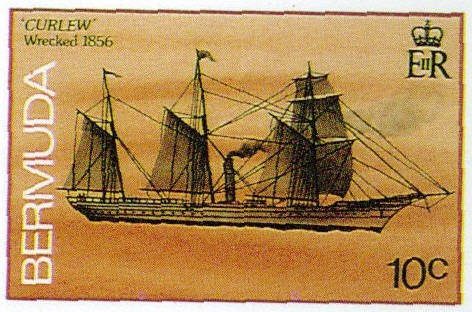
Image courtesy of the Government of Bermuda.
History
The Curlew was an iron-hulled, three-masted screw steamer rigged as a barquentine, built in Scotland in 1852 and 182 ft long. She first carried mail between New York, Bermuda and St Thomas, and after Cunard bought her on 20 July 1853 she ran its branch service linking Halifax, Bermuda and St Thomas in the Danish West Indies. She left Halifax under Captain Hunter on the morning of Friday 14 March 1856 with the English mails, a full cargo, ten head of oxen and three passengers: Mr and Mrs J. B. Howes and a Dr Dickey.
Howes wrote an account for the Royal Gazette a few days later. The wind and sea rose on Sunday and Hunter was on deck most of that night; Monday was fine, and the captain expected to sight the Bermuda light at about one in the morning and be in by six. At about half-past four on Tuesday 18 March Howes woke to hear the mate burst into the saloon and shout to the captain in his cabin that the ship had struck. She had run onto the northern reef about a mile and a half east of North Rock. Two boats were smashed as they were lowered and a third was washed off its davits, so everyone climbed into the main rigging for about an hour. The ship broke in two near the engine room and the stern sank almost at once, leaving only the forecastle above water. All but three then got away in the one sound boat and landed at the naval tanks on Ireland Island between ten and eleven; Hunter, the chief mate and the second engineer stayed with the wreck while boats from the two warships at Ireland Island, the Dockyard, Somerset and St George's went out to them. Everyone was saved. The sunken stern soon broke up, and seven of the nine mail bags floated free and were picked up, some of them two miles from the wreck; the two lost held newspapers and the North American letters.
The wreck was rediscovered and identified by Teddy Tucker in 1955, who raised brass fittings and other small finds, and the loss was commemorated on the 10-cent stamp of Bermuda's 1986-90 shipwreck series.
Diving the wreck today
A shallow, scenic dive in 15-35 ft of very clear water on the outer northern reef. The most recognisable remains are the engine's pistons standing between two small boilers; the rest of the wreckage is scattered and grown into the reef, covered in hard and soft corals. Suitable for most levels in calm conditions; often combined with other North Rock sites.
Where it is
Approximate position, for interest only - never use for navigation.
Pictures
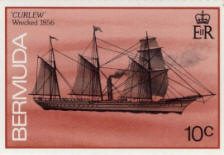 Bermuda postage stamp from the shipwreck series
Sources & further reading
- Bermuda 100 (UC San Diego) - Curlew
- Spink - Curlew wreck cover lot
- Bermuda.com - Bermuda's Shipwreck Postage Stamps
- Wikipedia - List of shipwrecks of North America
- Daniel & Denise Berg, Bermuda Shipwrecks: A Vacationing Diver's Guide (1991), pp. 25-26
- Custodian of Historic Wrecks, notice classifying open and restricted wrecks under s.6(1) of the Historic Wrecks Act 2001 (13 July 2007)
- The Royal Gazette, 25 March 1856, p. 2 - 'Total Loss of the Mail Steamer "Curlew"' (with passenger J. B. Howes's account)
- The Royal Gazette, Extra, 22 March 1856 - first report of the loss of the Curlew