Mary Celestia
Lost 1864 - Confederate blockade-runner, iron side-paddle steamer
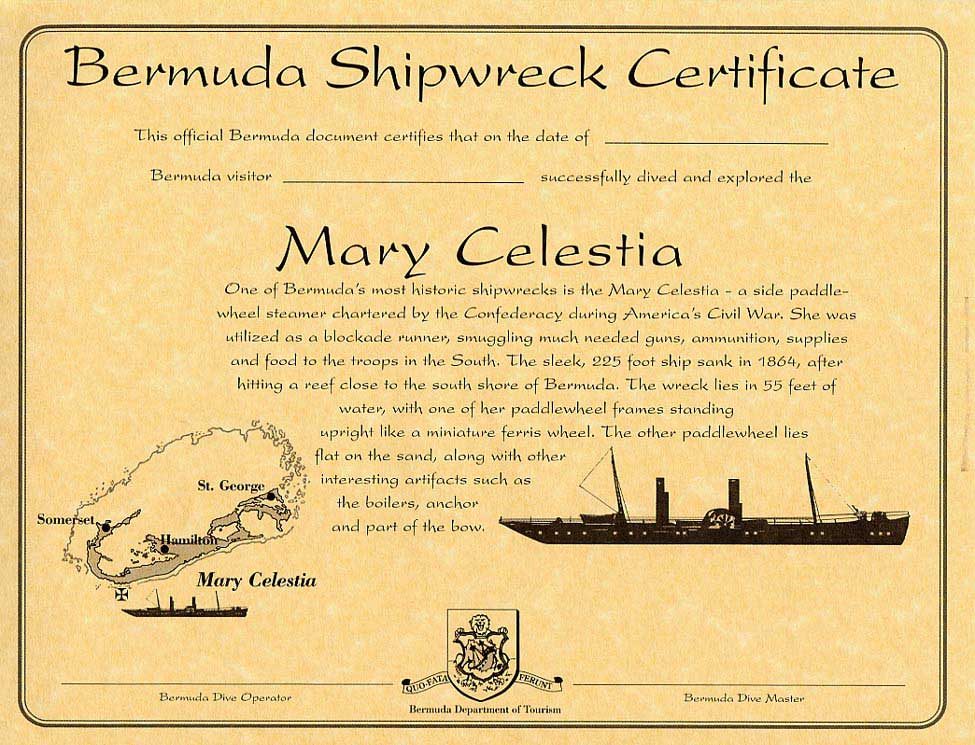
Image courtesy of the Government of Bermuda.
History
The Mary Celestia was one of the fast, low paddle steamers built in Britain to run the Union blockade of Confederate ports during the American Civil War. Completed in Liverpool in 1864 for the blockade-running firm Crenshaw & Co., she arrived at St George's new from Liverpool on 16 May 1864 under Captain Green, and through the summer she shuttled between Bermuda and Wilmington, North Carolina, bringing back cargoes of 500 to 680 bales of cotton. She sometimes used other names to confuse Union agents, and the Royal Gazette called her "one of the swiftest and most fortunate of her class". By August Captain Sinclair was in command.
On Tuesday 6 September 1864 she left Hamilton harbour with a full cargo, including bacon and general merchandise and, by some accounts, rifles and ammunition. On paper she was cleared for Nassau, as blockade-runners usually were. She made a quick run out through the East End channels and along the South Shore at about thirteen knots, with the Bermudian pilot John Virgin in charge. At about six o'clock she was turned towards the shore so that her owner, Colonel Crenshaw, and the pilot could land near Gibbs Hill Lighthouse. The first officer, Mr Stuart, pointed out breakers ahead, but the pilot replied, "I know every rock about here as well as I know my own house." Stuart ordered the helm hard down, but she struck almost at once and sank within six to eight minutes, in daylight and a smooth sea. The boats were cut loose and everyone was saved except the chief cook, who had gone back to his cabin for something he valued; one of the crew, Henry Adams, swam to a boat holding the ship's chronometer above the water. The Gazette called for the Pilot Commissioners to inquire into the loss.
Crenshaw Brothers put their agent, W. S. Doe, in charge of the wreck, and salvaged cargo was sold off in Hamilton during the following weeks. Southern sympathisers later accused the United States consul of having bribed the pilot, a charge that was never proved.
Storms in 2009-2010 scoured sand from the bow and exposed the forepeak, revealing sealed bottles of wine, perfume bottles and other goods. To protect them, a team including Bermuda's Custodian of Historic Wrecks and NOAA archaeologists excavated the forepeak in June 2011, recovering well-preserved woodwork, wine and personal items, some possibly hidden contraband.
Diving the wreck today
The wreck lies in a sand hole at about 55 ft, roughly half a mile offshore and close to the reef that sank her. The remains run in a straight line, highest amidships. The starboard paddlewheel frame still stands upright like a skeleton wheel and makes a classic photo backdrop; the other lies flat, and the boilers, engine parts, anchor and the bow, leaning on its port side, are easy to find. The surrounding reef has gullies and swim-throughs.
It is a straightforward dive for open-water divers in calm South Shore conditions and one of Bermuda's best-known Civil War sites. Leave everything in place; the site is protected.
Where it is
Approximate position, for interest only - never use for navigation.
Sources & further reading
- Department of Environment and Natural Resources - Mary Celestia
- NOAA - Archaeological excavation of the forepeak of the Civil War blockade runner Mary Celestia (Delgado et al. 2016)
- Bermuda Monetary Authority - Mary Celestia coin (2006 shipwreck series)
- National Geographic - Civil War wine from the Mary Celestia
- Bermuda 100 (UC San Diego) - The Mary Celestia
- Bermuda.com - Bermuda's Shipwreck Postage Stamps (1986 set)
- Daniel & Denise Berg, Bermuda Shipwrecks: A Vacationing Diver's Guide (1991), pp. 43-45
- Custodian of Historic Wrecks, notice classifying open and restricted wrecks under s.6(1) of the Historic Wrecks Act 2001 (13 July 2007)
- The Royal Gazette (Bermuda), 13 September 1864, p. 2 - 'Loss of the Steamer Mary Celestia'
- The Royal Gazette (Bermuda), 3 January 1865, p. 2 - 'The Year 1864'