Minerva
Lost 1795 - Armed merchant ship (ten guns); also a later schooner of the same name (1849)
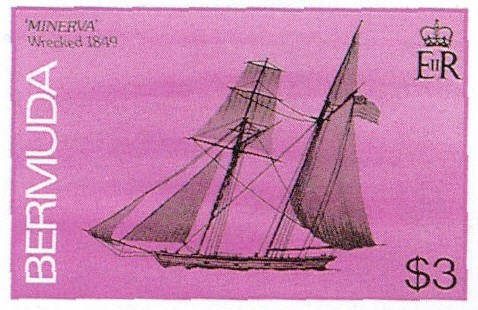
Image courtesy of the Government of Bermuda.
History
Two quite different ships share this name, and the old link between the Minerva and Ely's Harbour belongs to the second of them.
The Minerva of 1795. The Minerva lost in 1795 was an armed merchant ship of ten guns under John Arnot, bound from Portsmouth, Virginia, to the West Indies with a cargo of oak staves, heading, tobacco and plank (London reports, printed that June, named Norfolk and Tobago). On Thursday 9 April 1795 she ran onto the rocks off the West End, bilged, broke off her rudder and filled. Boats went out to her, but in the night she drifted off the reef and the offshore wind made it impossible to bring her in. Her arrival caused a scare in St George's: she kept the pilot boat's men on board, she was armed, and a strange ship and brig appeared offshore at the same time without making signals, so the militia were called out against a supposed enemy. She finished up lying on the bar near St George's Harbour, and on 28 April 1795 the wreck, with her masts, rigging, anchors, boats, guns and what had been saved of her cargo, was sold at public auction in St George's. If anything of her survives, it would be off the St George's end of the island, but no remains have ever been identified.
The schooner Minerva of 1849. The Minerva on Bermuda's 1986 shipwreck stamp ($3) is a different vessel: a Bermudian schooner owned by Captain Edward Smith and his brothers, merchants of Hamilton. On her first voyage, sailing home from Baltimore, she was knocked on her beam ends in a hurricane on 21 September 1849, four days out from the Chesapeake. Her masts went, and two days later the schooner Cornelia took off all thirteen people aboard and carried them to New York; neither vessel nor cargo was insured. Fourteen months later, at the end of October 1850, the branch pilot Thomas Cann found a waterlogged derelict west of the Hogfish Cut and towed it in. In Ely's Harbour she was found to be the Minerva, with books belonging to one of her passengers, Hugh Black, still aboard. The Royal Gazette thought it "singular" that she should drift the Atlantic so long and come home. She was sold by order of the Vice-Admiralty Court early in 1851. The story sometimes told, that she was a cedar ship bound for Africa, is not borne out by the reports of the time.
Diving the wreck today
There is no known dive site for either Minerva.
Sources & further reading
- Wikipedia - List of shipwrecks in 1795 (Minerva, Norfolk to Tobago)
- ShipwreckExpo (Dan Berg) - Minerva Wreck (archived)
- Bermuda.com - Bermuda's Shipwreck Postage Stamps (1986 set)
- Daniel & Denise Berg, Bermuda Shipwrecks: A Vacationing Diver's Guide (1991), p. 46
- The Bermuda Gazette, 11 April 1795, p. 4 - loss of the ship Minerva, John Arnot
- The Royal Gazette (Bermuda), 12 November 1850, p. 2 - 'The Derelict recently towed into Ely's Harbour'