Pelinaion
Lost 1940 - Steel-hulled cargo steamer
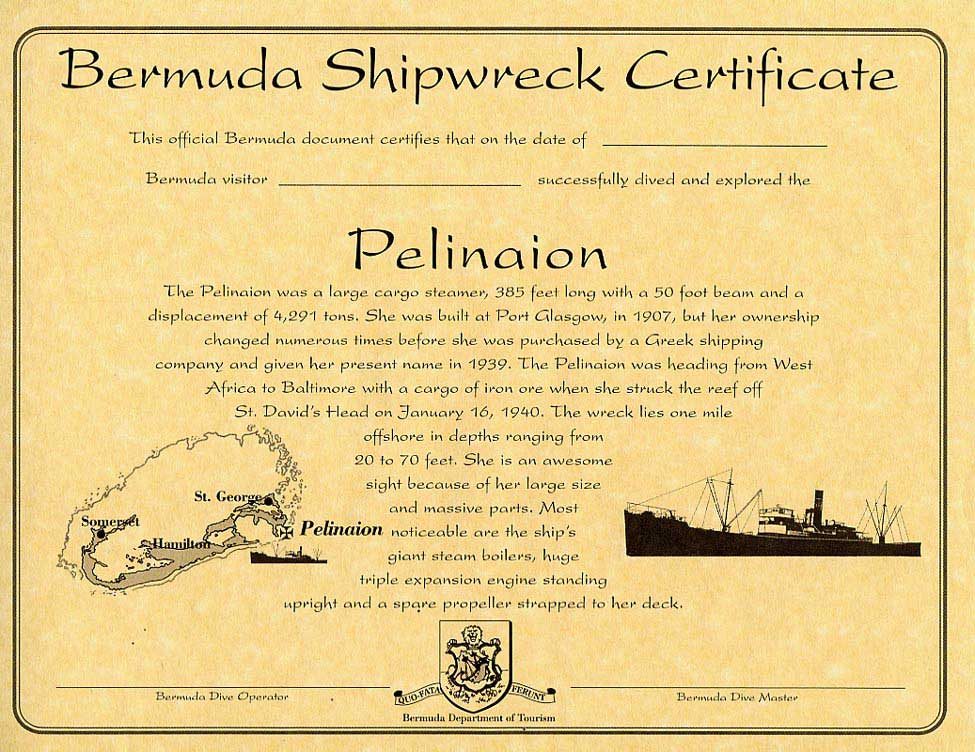
Image courtesy of the Government of Bermuda.
History
The Pelinaion began life in 1907 at Russell & Co.'s yard in Port Glasgow as the Hill Glen, a big tramp steamer of about 4,300 tons and 385 feet driven by a triple-expansion engine. Renamed Doonholm in 1914, she worked for a series of British tramp owners until a shipowner from Chios bought her in 1927 as the K. Ktistakis; she took the name she died under in 1939.
On 22 December 1939 she sailed from Takoradi, on the Gold Coast of West Africa, for Baltimore with manganese ore. The Second World War was only months old, and Bermuda had extinguished its lighthouses so as not to help German raiders and submarines. Her master, Captain Emanuel Volikas, put in towards Bermuda for coal (later accounts add that this was to be his last voyage before retirement). With no lights to guide him he decided to wait for daylight before entering St. George's, but in a rainstorm at 2.20 a.m. on 16 January 1940 she struck Black Rock, off the south-east side of St. David's. A naval patrol vessel, the Bermudian, had been watching her lights and signalling. Her SOS reported 'Big damage to engine room and hold full of water'; all 29 crew got off safely - though the ship's cat refused to leave. The Marine Court of Inquiry found an error of judgment rather than negligence: the captain had put too much faith in his noon position and should have slowed further or stood off and taken soundings. The crew left for New York a week later, but Ellis Island would not let 25 of them stay and they were sent on to Naples.
The wreck lies next to the Rita Zovetto - the Royal Gazette noted that she went ashore 'at the spot where the Italian ship' had stranded sixteen years before. Like her neighbour, she was worked over for non-ferrous scrap by local salvors after the war.
Diving the wreck today
Often called the best wreck on the East End. The bow sits on the reef at about 30 ft and the wreckage runs down to the stern in sand at 65-70 ft, so it suits both newer divers (shallow end) and experienced divers. Highlights are the huge boilers, the triple-expansion engine still standing upright and reaching to within about 10 ft of the surface, deck winches, an anchor and a spare propeller lying on the collapsed deck; a reef tunnel leads under the hull. Grunts, snapper, barracuda and angelfish are common. It is easy to get disoriented in the jumble of steel and reef, and the site is exposed to the open Atlantic, so pick a calm day.
Where it is
Approximate position, for interest only - never use for navigation.
Sources & further reading
- Bermuda Govt Conservation Services - The Pelinaion (1940)
- Bermuda 100 (UC San Diego) - The Pelinaion
- Bermuda.com - Pelinaion
- Wikipedia - List of shipwrecks of North America (Bermuda section)
- Daniel & Denise Berg, Bermuda Shipwrecks: A Vacationing Diver's Guide (1991), pp. 50-52
- Custodian of Historic Wrecks, notice classifying open and restricted wrecks under s.6(1) of the Historic Wrecks Act 2001 (13 July 2007)
- The Royal Gazette and Colonist Daily, 17 January 1940, p. 1 - 'Greek Ship Ashore Here Is Expected To Be Total Loss'
- The Royal Gazette and Colonist Daily, 21 February 1940, p. 1 - 'Court's Findings in Stranding of Freighter Pelinaion'