Pollockshields
Lost 1915 - Steel cargo steamer (ex-German, captured; British munitions carrier)
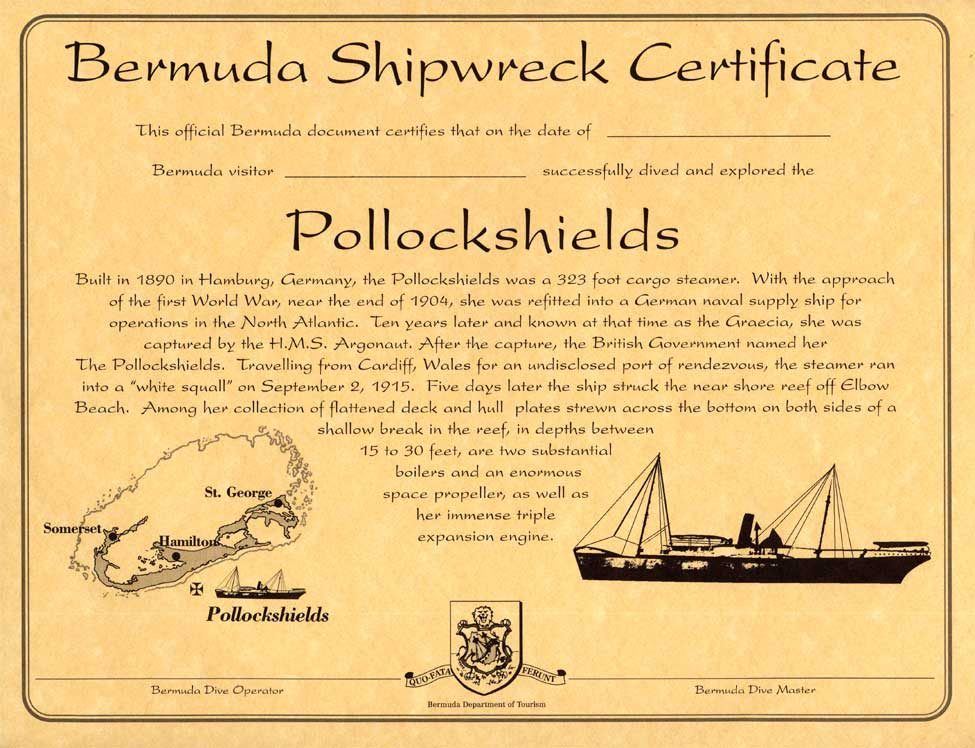
Image courtesy of the Government of Bermuda.
History
Pollockshields was built by Reiherstieg Schiffswerft in Hamburg in 1890 as the Herodot, and in 1903 passed to the Hamburg America Line as the Graecia. When the First World War began she was serving as a supply ship for German warships in the Atlantic; on 10 October 1914 she was captured by the cruiser HMS Argonaut, taken into British service, renamed Pollockshields and placed with the Newcastle firm Tyack & Branfoot.
On 22 August 1915 she left Cardiff for Bermuda with stores. Later accounts say she also carried some 350 tons of shells and powder - and shells still turn up on the site - though the Royal Gazette's reports never mention munitions and the inquiry found that she was riding light. From 2 September she struggled through storm-force seas and thick fog, and at about 8 a.m. on Tuesday 7 September 1915 she struck the barrier reef off the eastern end of Elbow Bay. As lifebelts were handed out the crew found they were one short; Captain Ernest Boothe went to fetch one for a fireman and was swept overboard by a sea. His body was later found below Gibbs Hill Lighthouse, and he was buried in Port Royal churchyard, leaving a wife and three children in England.
The rescue became a Bermuda legend. During the night a whaleboat was carried overland on Mr. Spurling's dray, and next morning a volunteer crew under the whaleman Antonio Marshall, who owned the boat - with Edward Dilworth, Charles DeShield, Gordon Bascombe, David Williams, T. Basden and Reginald Minors - put out through the surf. The first launch capsized; the second brought off all 33 survivors in four trips, watched by guests of the South Shore Hotel, today's Elbow Beach Hotel, where the men - English, Irish, American, Greek and Belgian - were looked after. Three kittens were saved too. A Marine Court of Inquiry blamed the thick weather but said soundings should have been taken; the Legislature voted the cost of the rescue, and the boat's crew received awards that December.
For decades her engine stood above the water and swimmers cut themselves on the coral-covered steel, so in 1960 the government had Teddy Tucker blast it down. From 1999 police and military divers removed most of the munitions, but shells still turn up after storms.
Diving the wreck today
A shallow, easy wreck dive and snorkel on the reef off Elbow Beach, from about 15 ft inside the reef line to just over 40 ft outside the breakers. The boilers, triple-expansion engine, propeller and scattered plating are all overgrown with coral, and fish life is good. Live shells and shell casings are still found on the site - look but never touch or remove anything. It can be snorkelled from the beach, but surge can be strong on the South Shore in a southerly swell, and on rough days a boat dive is the better choice.
Can you help?
Later accounts say the Pollockshields carried about 350 tons of shells and powder, yet the 1915 newspaper reports never mention them and the inquiry said she was light. Do you know where the munitions story comes from?
If you have information, photographs or family memories, please email [email protected]. Anything we use will be credited to you, with your permission.
Where it is
Approximate position, for interest only - never use for navigation.
Sources & further reading
- Bermuda 100 (UC San Diego) - The Pollockshields
- Bermuda Govt Conservation Services - Pollockshields
- Wikipedia - List of shipwrecks of North America (Bermuda section)
- Daniel & Denise Berg, Bermuda Shipwrecks: A Vacationing Diver's Guide (1991), pp. 52-54
- Custodian of Historic Wrecks, notice classifying open and restricted wrecks under s.6(1) of the Historic Wrecks Act 2001 (13 July 2007)
- The Royal Gazette, 9 September 1915, p. 1 - 'Wreck on the South Shore. Wonderful Scenes of Rescue'
- The Royal Gazette, 18 September 1915 - finding of the Marine Court of Inquiry, SS 'Pollokshields'